July 15, 2008
I don't need your affirmative action OR your pity
According to some, the
"lack" of women in science and engineering is so critical that Title IX-like protections should be put in place until women are equally represented.
Are you f*cking kidding me? Women have no barriers in science, probably fewer than in any other general field. Over half of students entering medical school this year are women. More than 60% of graduate students in biology and biochemistry and psychology are female. My department chair is a woman. There's no lack of women in science, even at the highest levels.
Yes, you might argue, but the article focuses on Physics and Engineering. And true, there are relatively few women in physics and engineering. But is it possible that maybe women don't choose these fields because they are less interested? Should we force girls into jobs they don't want? It's not like the demands of an academic career in physics are that different from the demands of an academic career in biology or biochemistry. Which even these researchers had to admit was the case:
[T]he institute found that women with physics degrees go on to doctorates, teaching jobs and tenure at the same rate that men do. The gender gap is a result of earlier decisions. While girls make up nearly half of high school physics students, they're less likely than boys to take Advanced Placement courses or go on to a college degree in physics.(emphasis mine)
At least the Universities so far are ignoring it:
So far, these Title IX compliance reviews haven't had much visible impact on campuses beyond inspiring a few complaints from faculty members. (The journal Science quoted Amber Miller, a physicist at Columbia, as calling her interview "a complete waste of time.") But some critics fear that the process could lead to a quota system that could seriously hurt scientific research and do more harm than good for women.
Yep. And considering today's cuts in research funding and endless Federal investigations looking for reasons to increase cuts, this could be a nightmare for small institutions that don't have the resources to bring in enough female scientists to meet an arbitrary quota.
Posted by: caltechgirl at
04:05 PM
| Comments (5)
| Add Comment
Post contains 369 words, total size 2 kb.
1
Must be the Barbie doll's fault! (heavy sarcasm...)
Posted by: Marie at July 15, 2008 06:00 PM (UunPp)
2
No doubt, certain quarters will attempt to even things up the same way they did in sports.
Posted by: Ken S, Fifth String on the Banjo of Life at July 15, 2008 08:26 PM (Yh9SA)
3
That's ridiculous. Women aren't majoring in it because they aren't interested or because they aren't comfortable yet. Some may be intimidated still when they walk in a class and its all men, but its not anything that they need to do TitleIX like protections.
And things are changing in the engineering community. Whereas I was consistently put down, to the dismay of my male coworkers my age, by management in the first 10 years of my career absolutely BECAUSE I was a woman and it was said to my face, I could run the show now if I wanted to. At work last month, the men were talking about how awful it was to be a woman in engineering even 10 years ago and how much its changed now. They said, "Bou, you would be running the world right now! You were just 10 years too early!" And they weren't joking.
It is the atmosphere has changed and women will start gravitating more towards it as they realize it. Word will spread... it will change.
As for Physics... I'll pass. Lack of interest...
Posted by: Bou at July 16, 2008 08:39 AM (Qj4UT)
4
"But is it possible that maybe women don't choose these fields because they are less interested? Should we force girls into jobs they don't want?"
Biologist here (so maybe not a "hard" scientist by some people's definition). I went into biology because it interested me. My dad suggested engineering, which in retrospect I might have been good at and might have found interesting - but I just wasn't interested at the time.
It's bull to "force" someone into a field they're less than interested in. Going the grad-school route (indispensable in most sciences) is soul-killing enough that you have to actually love your topic to be able to make it through.
And the whole quota thing drives me mad. What happened to hiring the most qualified person for a job, regardless of whether they stand or sit to pee, and regardless of what color their skin is (or where they go to worship, or where their grandparents came from...)
I got my job because (and I've had several colleagues tell me this and I have no reason to think they're lying) I WAS THE MOST QUALIFIED PERSON WHO APPLIED. I'd feel pretty crappy to think I got hired not because I was the "best," but because I have two X chromosomes.
Posted by: ricki at July 16, 2008 09:14 AM (O5SYw)
Posted by: 货架、 at March 01, 2009 07:49 AM (+Xe1F)
Hide Comments
| Add Comment
October 30, 2007
This wasn't a surprise
As I am clearly not
Aspie. But the number of questions about sneaking up on people was!
The
Aspie quiz:

h/t
Jay
Posted by: caltechgirl at
11:35 AM
| Comments (5)
| Add Comment
Post contains 28 words, total size 1 kb.
1
ACK! I'm not even going to tell you my score.
Posted by: Janette at October 30, 2007 12:08 PM (5R+zg)
2
Geeze... I think I must have answered something wrong...
Your Aspie score: 115 of 200
Your neurotypical (non-autistic) score: 93 of 200
You seem to have both Aspie and neurotypical traits
Must be lack of sleep... 2 hours in 48 is not the time to take a test... only 30 more minutes and I can give Tot his medicine... ugh
Posted by: vw bug at October 30, 2007 05:39 PM (FPOeI)
3
Do you like sniffing people or things? WTF??
Do you enjoy biting people - if they let you?
I grew impatient with the time it was taking to answer all the questions.
Posted by: DirtCrashr at October 31, 2007 11:47 AM (VNM5w)
4
My "diagram" looks almost the same as yours.
And WTF was with all those "are you good at estimating...?" questions. I cannot estimate ANYTHING accurately. (That is why God made rulers and speedometers). I suppose being very good at estimation is a typical "Aspie" trait or something.
(And I have to say I hate how they are cute-i-fying it to "Aspie.")
Posted by: ricki at November 01, 2007 06:54 AM (O5SYw)
5
My diagram looks nearly identical to yours too. I feel much better. I couldn't figure out what this neurotypical was... I must've missed that pargraph when scanning.
Posted by: Bou at November 04, 2007 09:04 PM (fGpp7)
Hide Comments
| Add Comment
September 03, 2007
From the DUUUUUH file
Kids whose parents model
responsible drinking at home, including letting the child have small amounts of alcohol in a family setting, are ONE THIRD as likely to develop severe binge-drinking behaviors in their teen and young adult years.
From the
Wall Street Journal:
What kind of parents would ever allow their children to drink at home? Doesn't this put youngsters at risk?
The answer to the first question is simple. Most of the state laws include a specific exemption for children drinking at home during family and religious ceremonies. Observant Jews, for example, traditionally serve children small glasses of wine during Friday night Sabbath ceremonies. Other cultures also begin socializing children into drinking at an early age--including Mediterranean societies such as Italy, Greece and Turkey (and non-Mediterranean societies such as China).
As for the second, two international surveys--one conducted by the World Health Organization--revealed that these Mediterranean countries and Israel had the lowest binge drinking rates among European adolescents.
In societies where children drink with their parents, this typically means giving a kid a small amount of wine or other alcohol, often watered down on special occasions or a family dinner. Many European countries also lower the drinking age for children when they are accompanied by parents. In the United Kingdom, for example, the legal age is 18, but for a family at a restaurant it is 16. In France and Italy, where the legal age is 16, there is no age limit for children drinking with parents.
But what might all of this mean for teen drinking problems in America?
Several studies have shown that the younger kids are when they start to drink, the more likely they are to develop severe drinking problems. But the kind of drinking these studies mean--drinking in the woods to get bombed or at unattended homes--is particularly high risk.
Research published in the Journal of Adolescent Health in 2004 found that adolescents whose parents permitted them to attend unchaperoned parties where drinking occurred had twice the average binge-drinking rate. But the study also had another, more arresting conclusion: Children whose parents introduced drinking to the children at home were one-third as likely to binge.
"It appears that parents who model responsible drinking behaviors have the potential to teach their children the same," noted Kristie Foley, the principal author of the study. While the phrasing was cautious, the implication of the study's finding needs to be highlighted: Parents who do not introduce children to alcohol in a home setting might be setting them up to become binge drinkers later on. You will not likely hear this at your school's parent drug- and alcohol-awareness nights.
So why file this under DUH? Because it's the first principle of adolescent psychology: If you want a kid to NOT do something, take away its taboo. The driving force of childhood is to find one's place in the world. To learn the rules and decide which are important to follow, and which aren't. Teenagers in particular make this an art form, with their kid's minds in little adult bodies. Kids who occasionally share small amounts of alcohol with their parents do not see drinking as either rebellion or escape, because it's something they do in the confines of the family. It's just not "cool" if Mom and Dad do it with you, right?
This is not to say that it's ok for parents to do this with other drugs. Alcohol is the least likely of the drugs of abuse to have adverse consequences on brain development, especially in the small quantities relevant to these studies. A single dose of cough syrup is likely to have more alcohol in it that whatever a child consumes in a responsible home setting.
Nice to see common sense coming out of psychosocial research for a change.
h/t
HWNNL
Posted by: caltechgirl at
12:14 PM
| Comments (8)
| Add Comment
Post contains 630 words, total size 4 kb.
1
I agree wholeheartedly with your statement:
"Because it's the first principle of adolescent psychology: If you want a kid to NOT do something, take away its taboo."
I do not believe, however, the comparison with European and Mediterranean Society's is comparing apples to apples.
I believe the 'drinking' sited in most of these studies is referring to an alcoholic beverage as an accompaniment with a meal. That would be wonderful if it was the case in the U.S., but I believe it is far from how drinking is viewed here.
In the United States, the psychology of drinking is not as an accompaniment to a meal but rather the drinking is viewed as an end in itself.
And it's not just the parents doing the influencing.
Our TV screens are filled with the idea that drinking is THE MOST IMPORTANT activity, bar none. A recent Heineken ad tells us "It's all about the beer"; another beer ad shows a young girl's excitement over a blue strip on a pregnancy test completely dashed by her husband's excitement over his beer label turning blue; and my personal 'favorite', a couple of years ago a commercial shows the party in Heaven coming to a halt because the beer runs out. The angels then cause cases of beer to fall off a delivery truck and the broken bottles' spirit floats up to heaven, so the party can resume.
The U.S. has elevated drinking - and particularly beer drinking - as the ultimate means of having a good time.
A meal with the family never enters the picture.
Until we urge our lawmakers to initiate laws to reduce the glamorization of beer drinking on TV, similar to the restrictions on cigarette advertising, drinking in this country will always be the supposed cool thing to do.
Joe Lukawitz
Nashua, New Hampshire
Posted by: Joe Lukawitz at September 03, 2007 04:51 PM (WXIEq)
2
A drink with a meal is most assuredly NOT the kind of drinking most Americans think of, but this is the behavior under study here, and it seems that this type of drinking at home can prevent the kind of drinking/partying behavior most common among teens and young adults in this country. Amazing.
Posted by: caltechgirl at September 03, 2007 06:36 PM (IfXtw)
3
I have pictures of sherlock as a 7 or 8 year old slamming shots of Aguardiente (some serious liquor).
We drink socially, but are more likely not to drink if RTY is with us (mostly because we have her so infrequently, we don't want alcohol hindering in any way). We are very likely, however, to have a glass of wine with dinner and save the mixed beverages for parties.
(Well, except for from about the end of September through the beginning of January when I have my seasonal depression and drink vodka like water to ameliorate my mood.)
Posted by: wRitErsbLock at September 03, 2007 06:37 PM (0Pi1o)
4
This may be one of those cases where it's difficult to tease out the elements of causation vs. correlation. Alcoholism tends to run in families, so if you start out with alcoholic parents, there's a good chance their kids will abuse alcohol too, regardless of what behavior the parents model (which, given their own issues with alcohol, will either be teetotaling or hard-core abuse, while healthy parents model healthier, more moderate behavior).
Posted by: Xrlq at September 03, 2007 08:40 PM (zf9t4)
5
I realize I'm a data point of one, here, but - when my parents drank, it was wine (or a beer) with a meal. My brother and I were allowed tiny tastes of wine (or beer, except I never could get past the SMELL of beer to want to taste it) as teens.
Neither of us drank in college (I don't drink now after learning that even a half-glass of wine is enough to fire up a nearly-instantaneous migraine). My brother drinks beer and wine but only with meals, and never to excess.
I think maybe having parents who behave responsibly CAN help counteract the "slam some brewskis!!!" model that is presented for American drinking. (If I think about consuming alcohol, usually my first thought is of a couple at the dinner table sharing a half-bottle of wine over dinner.) I always thought the kids in the dorm who got wasted every Saturday night (and paid for it every Sunday) were kind of stupid. Observed from the outside, it seemed to me that the high wasn't worth the hangover, or the fear of having done something really irresponsible while under the influence.
Posted by: ricki at September 04, 2007 05:28 AM (O5SYw)
6
CTG - you are absolutely correct.
While there will always be alcoholics - I've always said we could very likely stop much of the binging and over the top drinking if we stopped looking at the drinking itself as the most evil thing in the world.
By all means have extremely strict rules about drinking and driving... but leave it alone when people are drinking at home and will be staying there. *sigh*
We're being pushed back into Prohibition and we all know how well THAT worked. Sheesh!
Posted by: Teresa at September 04, 2007 08:52 AM (rVIv9)
7
I was able to drink at the tender age of 18 -yeah, I'm old. My children will have tasted several beers and beer styles before they reach the age of 21. In fact, if they want to watch the game with their old man while sipping on a brew, I'll be glad to supply it.
I'll admit to having broken the law since the federal government decided to extort the states during the Reagan administration. I use to work with some 18-20 year olds, pretty responsible kids. After a 60+ hour week, they wanted to chill out in front of the TV while drinking a beer. I knew that they wouldn't be driving anywhere so I bought them beer. And I'd do it again. Like, say, when my children are somewhat older.
This "federal" law has irked my since it was enacted, and I wasn't even affected by it. I contend that if you aren't deemed adult enough to drink responsibly, you shouldn't be able to vote, serve in the armed forces, or be tried as an adult. I'm all in favor of extravgant punishment for douchebags who drive drunk, but treating 18-20 year olds like children is absurd.
For what it's worth, there are some people advocating raising the drinking age to 25 or more, which should be a tipoff that this isn't about protecting the children. It's merely another step down the roads towards Prohibition, Part II.
Posted by: physics geek at September 04, 2007 09:51 AM (MT22W)
8
My parents gave us small glasses of wine on holidays (basically, whenever everyone else was having it, which when I was little was just holidays). If they were having a beer, they let us taste it. They never drank to excess in front of us. It works. It was never some weird mystical thing that I didn't know about.
Posted by: silvermine at September 05, 2007 03:55 PM (4gdyI)
Hide Comments
| Add Comment
July 03, 2007
Man is prone to evil as the sparks fly upward....
Babies as young as 6 months are
capable of deception:
Behavioural experts have found that infants begin to lie from as young as six months. Simple fibs help to train them for more complex deceptions in later life.
Until now, psychologists had thought the developing brains were not capable of the difficult art of lying until four years old.
Following studies of more than 50 children and interviews with parents, Dr Vasudevi Reddy, of the University of Portsmouth's psychology department, says she has identified seven categories of deception used between six months and three-years-old.
Infants quickly learnt that using tactics such as fake crying and pretend laughing could win them attention. By eight months, more difficult deceptions became apparent, such as concealing forbidden activities or trying to distract parents' attention.
By the age of two, toddlers could use far more devious techniques, such as bluffing when threatened with a punishment.
Dr Reddy said: "Fake crying is one of the earliest forms of deception to emerge, and infants use it to get attention even though nothing is wrong. You can tell, as they will then pause while they wait to hear if their mother is responding, before crying again.
"It demonstrates they're clearly able to distinguish that what they are doing will have an effect. This is essentially all adults do when they tell lies, except in adults it becomes more morally loaded."
So babies are pushing their boundaries almost from day 1. It's really no surprise to a developmental biologist. Children's brains are built to explore, and from the moment they exit the womb they are continually surveying their environment for cues as to "the rules", this includes everything from object permanence to gravity, to the social niceties of their individual culture. These early manipulations are simply another form of exploration; that is, figuring out how to most effectively get the reward (attention, approval, toys, food, etc.) that they want.
It kind of makes me sad though, as I'd prefer to see babies as little innocents, rather than this more cynical view of children as pre-programed manipulation machines.
Oh, and 10 points to the first person who identifies the source of the title....don't Google it, Google has a bunch of sources....
h/t Wired Science
Posted by: caltechgirl at
07:30 PM
| Comments (3)
| Add Comment
Post contains 392 words, total size 3 kb.
1
Evil little monsters, I tells ya!
Actually, this is not a surprise to most parents. We've all seen the fake cough, the fake crying, the fake laughing. We're not fooled.
The more perceptive of us have also seen the fake IDs, the forged pink slips, and the bogus credit cards, though a lot of that goes unnoticed and unpunished...
Posted by: Ken S, Fifth String on the Banjo of Life at July 03, 2007 08:15 PM (Yh9SA)
2
Especially when the kids cuts us in on the action.
Posted by: Ken S, Fifth String on the Banjo of Life at July 03, 2007 08:16 PM (Yh9SA)
3
"Until now, psychologists had thought the developing brains were not capable of the difficult art of lying until four years old."
Evidently, these psychologists have not actually lived with children under four years old.
Posted by: Robbo the Llama Butcher at July 05, 2007 08:47 AM (0JsTF)
Hide Comments
| Add Comment
February 20, 2007
Pregnancy may lead to a new therapy for MS
Researchers at the University of Calgary
have discovered that the pregnancy associated hormone prolactin may be responsible for the reduction of MS symptoms usually occurring during pregnancy.
The study, published in the Journal of Neuroscience, indicated that prolactin could be used in people to repair damage caused by MS and improve their symptoms.
Pregnant mice had many more myelin-producing cells, known as oligodendrocytes, than virgin female mice of the same age, the study found.
The researchers destroyed myelin around the nerve cells in the mice, as occurs in MS. Two weeks later, the pregnant mice had twice as much new myelin as the other mice. When the scientists injected prolactin into the non-pregnant mice, their myelin similarly was repaired.
"The implications are that prolactin may be a molecule that can be tested in MS patients for stimulating repair," Samuel Weiss, director of the Hotchkiss Brain Institute at the University of Calgary and senior author of the study, said in an interview.
Prolactin increases in the body during pregnancy and is involved in stimulating milk production among other things.
It's a quite common finding that women with MANY different auto-immune disorders have fewer symptoms during their pregnancies. It will be EXTREMELY interesting to see if the prolactin findings can be extended to other disorders, and whether the mechanism of prolactin is specific to myelin production or facilitates increased myelin levels indirectly via a protection mechanism. Or if other pregnancy hormones have similar effects, especially as inflammatory exposure can have devastating effects on a developing fetus.
Posted by: caltechgirl at
03:03 PM
| No Comments
| Add Comment
Post contains 266 words, total size 2 kb.
September 19, 2006
A Gender Gap in Science?
This study came out recently, and I'm not sure how I feel about it. Ok, that's wrong. On the face,
without having read the actual text yet, I disagree with [the media's presentation of] it ENTIRELY.
You see, there's a very important factor that either they've overlooked or the media has chosen not to report....
Let me explain:
First of all, I want to make it clear that I've never experienced that kind of discrimination personally. As an undergrad, while Caltech had 4 times as many males on campus as females, the Bio department was almost 50-50. In graduate school, out of about 30 students in my program, 6 were guys. My advisor was female, too. So was her postdoctoral advisor.
Here, half of my department is female, including our chair.
But on to my main point:
One thing the study doesn't seem to consider is that women often PREFER to opt out of the higher academic jobs because of the demanding schedule. We CHOOSE to remain in a comfortable lab, where our schedule is more flexible, we can work with the people we choose to work with, and we have time to be ourselves and actually SEE our families.
This is the elephant in the living room. Academic Science has many of them.
Sure, a lot of women who are Dr. Shalala's age and even up to 20 years younger had to deal with chauvinist pigs and glass ceilings and all that. They had to CHOOSE between a career and a family. Women scientists of MY generation can have both, and are frequently choosing personal fulfillment over professional, in many cases. I did. That's why I teach, rather than pursuing a traditional academic career track.
What these older chickies can't stand is the rearrangement of priorities in younger female scientists. They hate it that we wouldn't follow them blindly through the glass ceiling, that we can stop about a foot lower and say "Thanks, I'm good." That we refuse to blaze their trail just because it's there.
I'm not naive enough to say that discrimination DOESN'T exist. However, that doesn't mean that gender-based discrimination is the ONLY reason why women don't get the highest jobs in academic science and engineering. And it's naive of THEM to say otherwise.
Posted by: caltechgirl at
11:27 AM
| Comments (16)
| Add Comment
Post contains 385 words, total size 2 kb.
Posted by: Amanda at September 19, 2006 11:35 AM (ay+rD)
2
You make some really good points and I would agree that discrimination isn't the
only reason, however in some sciences - for example, Computer Science (my field) - it definitely exists and is a huge problem. There are many studies that I've run across that indicate that the discrimination problem isn't as pronounced in sciences other than CS - and for that I'm grateful.
Why we have such a problem in CS, I'm not sure - and neither is the majority of the CS world. But it's not even all discrimination - some of it is the perception of discrimination that chases young women out of the field before they really give it a fair shake. Some of it is stereotypical profiling of the "computer geek". And some of it is the boys club attitude found in CS departments - even amongst students. I ran into to it to a degree in my undergrad and got around it primarily by either self-deprication (deflect their posturing with blondeness and it loses its appeal) or simple tom-boyishness (which wasn't a stretch for me, still isn't.) (But I was the sole female in the major all four years.) Ran into it some in my MS but got around it by saying I wanted to teach (a traditionally female role.) (Was one of probably 5 females in the Master's program). Run into it daily in my corporate job - haven't figured a way out of it yet because I don't want to be the discrimination chick.
Anyway, in some scientific fields it really is a problem - not always for the reasons they state, and we shouldn't negate or neglect the points you raise either.
Posted by: beth at September 19, 2006 02:33 PM (RrqeO)
3
I was one of very few females at the time in my field of Computer Science. Hey, I graduated in '89. What I ran into was that most of the women I worked with had 'an attitude'. Which in turn fed the 'good ol boys' and ... you get the picture. The few times I ran into some kind of harassment, I met it head on and it was solved. Like telling the VP my eyes were on my head not on my chest. But believe it or not, I had more issues with the women. I had a woman boss who did not want to give me a raise because I didn't give 120%. Like you, I enjoyed my vacations and family time (though I did not have children at the time). She couldn't understand why I didn't want to work 80 hours a week and 'show the men up'. Uhhh. Considering I was doing the same work as a man who was 2 levels senior to me, why would have I have to do any more to 'show someone up'? sigh... you got me started. I'll stop here. Enjoy your life. Don't let the ones with no self assurance get you down.
Posted by: vw bug at September 19, 2006 07:02 PM (HVeEK)
Posted by: rightwingprof at September 20, 2006 07:26 AM (hj1Wx)
5
Oh man I could say so much..., but I will summarize.... (from the Engineerign side).
School:
- University was 60/40 female, Science was majority male, which was skewed by engineering, scinces were closer togehter.
- Quite a few women left engineering because they weren't intererested. (Isn't that what women with freedom are allowed to do?)
- On a random note, while in school they would "express concern over the number of women in engineering", they never commented that 2 out of 60 students in psychology were male.
Work:
Private Sector:
- Women who strted with me advance at relatively the same rate, where all pretty much at the same point.
- Quite a few Sr. Level women I have met/worked with are single or divorced. However, many of them achivied the most while single and cut back for marrage or children.
- There is a slight bias in favor of hiring women & minorites driven by government affirmative action requirements in contracts.
Public:
- Not too much going on here, up to a certian level, the work you do relates in no way to moving up in the agency, call it the ability to "fail upwards".
- There are soem high level women in public agencies and they bust there ass and put their time in like their male counterparts.
- Once again a slight advantage to women & minorites depending on the agency.
But over all, if women choose their career, career path and how far they want to advance in their career...what the hell is the problem?
Posted by: the Pirate at September 20, 2006 08:49 AM (tM0AO)
6
Very well said.
Your comments also apply to professions other than science.
Posted by: Christina at September 20, 2006 08:53 AM (Slc5L)
7
YEP! That's why I quit grad school (biophysics) and I'm now a programmer with two kids.
It was pretty much expected you'd stay in the lab until 1 or 3 am, and (if you were on the "bad campus" in downtown Baltimore) that meant you were stuck there until morning. The last safe bus left at 11.
That's just nuts. I decided I actually wanted to see my husband and not be crazy. (That and I wanted to be paid, and get credit for what I did, and all that fun stuff.)
Oh, plus I didn't get into my top FIVE choices of lab. Not sure why. A few of them someone else just got to before I did, which is normal... but three of them wouldn't even let me do a rotation. And they weren't all full -- they let some of my fellow students do rotations. Male? Yeah. But I think it was more likely discrimination against the biologist. (My degree is in Molecular biology and all the other students were physics majors. If they had a problem with that or what I wanted to study (which I stated VERY CLEARLY when I interviewed) they shouldn't have accepted me.)
Posted by: silvermine at September 20, 2006 12:50 PM (hn7Rm)
8
Yep. There's something to be said for contentment. Not everyone wants to climb the ladder like a raging bull. Some who are that type become so bitter. As they say -- you never read on a tombstone that John Doe wished he'd spent more time at the office.
My closest college friends and I were math majors, at a school known for its rigorous math program. I recall our classes being pretty much 50/50 with females to males. And that was in the mid-80s.
Just because we haven't chosen to move mountains with our brains doesn't mean we don't have the aptitude.
It's all about making thoughtful choices.
Posted by: Marie at September 21, 2006 06:30 AM (XzzJz)
9
I just wish that some people could ACCEPT that we're "good" with where we are. I've had people (at meetings, etc.) look at me in disbelief when they find out I don't live in the lab.
eh, whatever. I don't have a spouse/kids but I'm still interested in having a life outside of research.
Which is why I'm at a small, teaching-focused college. I'm pretty happy (but do regularly complain that they need to raise admission standards). If I'm doing well, I publish an article in a minor journal every year and in a "national" journal every two or three years. And I'm not expected to bring in megabucks in grants - I'm kind of left alone to pursue what interests me, and that is what makes me happy.
I think in some sectors there's almost a reverse discrimination - that there are some women that think that if you're not taking a battering ram to some perceived glass ceiling, if you're not engaging in every pissing contest, if you're not trying to forcibly change the world, then you're wasting your time and you're actually a detriment to "the movement." Feh. There's a lot to be said for being happy. And what's to say I'm not changing the world, but that I'm doing it in a different way - through inspiring a student or maybe even doing something OUTSIDE of my work-field.
Posted by: ricki at September 21, 2006 06:35 AM (VRP1v)
10
Thank you!
It's significant that none of these studies ever look at science faculty at small, primarily teaching schools. There, faculty tends to be a lot more balanced even in the physical science. My tiny five-person chemistry/physics department has two women, and in our last two searches, at least half the applicants were women. The evidence on this is anecdotal, since no one's really crunched the numbers, but from those I know who looked for small-school academic jobs, a lot of women are opting to go that route if they want to teach and do research. The job is less focused than it would be at a research university, but is also more flexible and less stressful, plus getting to know your students is expected rather than avoided!
Posted by: Wade at September 21, 2006 08:20 AM (oK1Vc)
11
They hate it that we wouldn't follow them blindly through the glass ceiling, that we can stop about a foot lower and say "Thanks, I'm good."
Oh God, AMEN.
I do work in a scientific field-I'm an engineer, and the only female one of those in a sea of males. It's not that I don't think I can break through the glass ceiling (which, come to think of it, I don't think can be done)-it's that I don't see the point. I don't want to be a CEO-why take all that stress and pressure?
Being resilient shouldn't be read as being wimpy.
Posted by: Helen at September 21, 2006 11:32 PM (sxb5W)
12
Terrific post. You have made some excellent points here.
Posted by: Richmond at September 22, 2006 11:58 AM (e8QFP)
13
I think you make some good points, that possibly women are more likely to prioritise family and other important parts of life over personal ambition and climbing the career ladder. But, to me, the more interesting question is why this is so. It seems unlikely that it's a coincidence or entirely biologically determined, and I think it's obvious that there is pressure on women to put their own ambitions second to family life etc, when there is often no such pressure on their male counterparts.
Also it works both ways, maybe men are under undue pressure to advance their careers and they miss out on things like spending time with their young children, having a fulfilling life outside of work etc. I think that what we need is a balance between the two extremes for everyone, and a recognition that both career and family are important.
Hopefully this would lead to an improved situation for both women and men, and would even out the gender gap at work and also at home and in childcare.
Posted by: Sarah at September 23, 2006 10:24 AM (KrCMZ)
14
Thanks for you comment over at my
Weekend Pundit discussion of the same topic. Though I haven't read the book you dismiss, the excellent point you raise in your entry is valid. But why?
The 1991 book Brain Sex by Anne Moirs and David Jessel, which sponsored a revolution to my then-feminist mode of thinking, states it in one word: testosterone.
It's why there are so few female UPS drivers, for instance. Women don't have the drive, no pun intended, to do package delivery for 10 hours a day, a brutal though excellent way for a low-skill guy to make a living. It does have its drawbacks: after air traffic controllers, UPS drivers have the highest rate of divorce of any occupation.
A nice way of looking at it is that brains, which are wired in utero, reconfirm a rather traditional view of the sexes. Your need to have more of a flex schedule, even though you're just as good or better than your male peers, means that advancement will be denied you more often during the course of a career.
At times, though, this is circumvented by affirmative action. But I for one oppose treating people in any other way than as individuals when it comes to the law and the marketplace.
BTW, have you seen the Wikipedia entry on Donna Shalala? It's funny when it goes she's never been married "wink, wink."
Posted by: Brent at September 24, 2006 07:01 AM (i+uCz)
15
For her contribution to utterly unsupported and damaging literature about women and society I have awarded Brizendine the first annual "More Likely to Be Killed By a Terrorist Than Marry Retraction" award, named for the 1986 Newsweek story, retracted this year. See my blog, http://gettoworkmanifesto.com/blog/, for the details. Put another way, A Million Little Made Up Footnotes.
Posted by: Linda Hirshman at September 26, 2006 02:41 PM (2pxF1)
16
Should not be necessary, but I'll mention that this post was a response to the prior comment that it's hard wired in utero, just another example of the poison spread in the social discourse by the Terrorist Retraction Award winning "Female Brain."
Posted by: Linda Hirshman at September 26, 2006 02:44 PM (2pxF1)
Hide Comments
| Add Comment
August 10, 2006
Your daily rant
don't fucking get me started on
these quacks.
Here's what got me:
"Head cases A few neurological differences between women and men from Louann Brizendine's "The Female Brain":
Thoughts about sex enter women's brains once every couple of days; for men, thoughts about sex occur every minute.
Women use 20,000 words per day; men use 7,000 per day.
Women excel at knowing what people are feeling; men have difficulty spotting an emotion unless someone cries or threatens bodily harm.
Women remember fights that a man insists never happened.
Women over 50 are more likely to initiate divorce."
NONE OF THESE ARE NEUROLOGICAL DIFFERENCES!
SOME of them have to do with functionality/ functional outcome, but for FUCK's SAKE, is it AT ALL responsible to say that because a woman is over 50 that she files for divorce because her brain is hard-wired to do so???? I mean COME ON.
MAYBE MAYBE you COULD make the case that women's brains are MORE dependent on the influence of sex hormones than men's and that after menopause function is decreased BECAUSE hormone levels drop.
Sorry to be so mad, but while I am technically a developmental neurobiologist, I am ALSO a neuroendocrinologist. Which means I study how hormone signals affect the brain. This is my field, folks.
It is ENTIRELY not clear that the differences in the way women and men think are at all somatic (body-based) rather than socially nurtured. There is a growing body of evidence that Estrogen and Testosterone drive certain biological processes in the brain, HOWEVER, E and T are both converted to the same physiologically active molecule (they're not that different to begin with). Some of the proposed difference may have to do with feedback mechanisms based on progesterone (P), which women have in abundance compared to men.
The idiot who wrote this book argues that women's brains are "wired for communication". Sure, fine, but IT IS NOT AT ALL CLEAR based on the available evidence that this wiring is a direct effect of having 2 X chromosomes. MUCH of the wiring in our brains, and in fact the very essence of what we believe about learning and memory, is based on our experience. The neurological imprint of experience shapes the pattern of wiring in our brains. If we speak multiple languages as children, for example, we are more able as adults to learn and comprehend multiple languages, as our brains are wired for it. Because Estrogen and Progesterone affect the processes of wiring, that may play a small role, but clearly, experience is the basis of preferential wiring and preferential connectivity.
There are some anatomical differences in the brains of men and women. First of all, men have bigger brains. No shit. They have bigger bodies. They also have bigger feet. the overlap is also pretty significant. There are some small areas within the brain that are smaller or larger between the sexes, most notably an area in the hypothalamus smaller than the end of your pinky that is significantly different between the sexes (except, purportedly in homosexuals....) according to Simon LeVay back in the late 80s/early90s. He's a pretty well respected researcher, even though some of his stuff is pretty controversial, like that study.
Grrrr.
Also, she talks about hormone cycling and clinical trials, and thats no longer a valid excuse. Women MUST be included in ALL trials where a therapeutic benefit to females may be achieved (so, that's everything but things like prostate cancer or ED...). Women who participate in studies that may be affected by their hormones have to keep track of their cycles and note if they are taking any other medications that could alter hormone levels or function, such as birth control, HRT, anti-cholesterol medications (statins especially), and some antibiotics. These factors are generally accounted for, and generally make no difference.
To sum up, while the premise of the book is not entrely bogus, based on her arguments in the interview and the "neurological differences" presented at the end, it is clear that this book is full of inconclusive data and incomplete understanding, and should be viewed as a POSSIBLE explanation for some of the cognitive/ personality/ functional differences between the sexes. And a far too simple one, at that.
Just also wanted to point out that it appears that the author of this book is in fact a "real" scientist, who evidently publishes research about hormones and depression.... So perhaps this book is an extended theoretical paper.
Posted by: caltechgirl at
11:43 AM
| Comments (5)
| Add Comment
Post contains 749 words, total size 8 kb.
1
I think YOU should write a book...I actually understand science stuff when you explain it!!
Posted by: Amanda at August 10, 2006 12:22 PM (ay+rD)
2
And how does she explain the women who want it 3 times a day after the age of 30? Trust me when I say I am not the only one that has reached that point (though I think it has to do more with how you feel about yourself than 'wiring')... And I agree with Amanda. You make more sense and I like it better.
Posted by: vw bug at August 10, 2006 01:32 PM (86xHT)
3
But are you really mad? It's hard to tell, since you didn't threaten bodily harm to the writer. (From a woman who actually does have a hard time figuring out what people are feeling most of the time, and who has a 7-year-old son who has a larger vocabulary than some teenagers and is
extremely verbal.)
Posted by: Jenna at August 11, 2006 07:45 AM (fd/rX)
Posted by: Ken S, Fifth String on the Banjo of Life at August 11, 2006 11:13 AM (UefPN)
5
She also claims, "It has become more OK to talk about brain differences between genders over the past few years," - yeh right, tell that to Larry Summers, former president of Harvard... It's only possible to do so if you're a woman. She gets to make her speach on the body of "an old, dead, white, male."
Posted by: DirtCrashr at August 11, 2006 12:57 PM (VNM5w)
Hide Comments
| Add Comment
January 26, 2006
WooHoo!
Not that any of you care, but my first multi-million dollar grant application is going out the door this afternoon. Well, ok, not mine alone, but I am Co-PI. Holy Crap!
Damn I feel old. This time last year I was writing my thesis.....
Posted by: caltechgirl at
02:49 PM
| Comments (4)
| Add Comment
Post contains 45 words, total size 1 kb.
1
Congratulations! You have just funded yourself a junket to Molokai. Expense under administrative overhead. I really don't know much about the grant game, just thinkng out loud for you.
Posted by: Velociman at January 26, 2006 04:27 PM (f9lXT)
2
Congratulations. Would you write one for me? I could use some more cash.
Posted by: Contagion at January 26, 2006 05:37 PM (e8b4J)
3
Yay! Congrats, um, you know feel free to kick any extra y'all get this way. I'll make sure to, um, research human behavior with it.
Of course by human behavior I mean hot chicks pole dancing and by research I mean hand them $20's during their performances.
Posted by: phin at January 26, 2006 05:46 PM (DGPlf)
4
Can you tell us more about it if it is accepted? What does Co-PI stand for? I can guess to Co, but what is the PI?
Posted by: Amy at January 29, 2006 06:48 PM (JFN4H)
Hide Comments
| Add Comment
November 28, 2005
This is a bit much
From Stingflower of new bloggy find
Harshly Mellow, who also finds
this creepy:
A tenth of two to five-year-olds have a serious psychiatric illness, yet most cases are being missed, warn experts.
The problems go beyond tantrums and bad behaviour and impact negatively on all aspects of an infant's life, the Institute of Psychiatry will hear.
And failure to spot and treat these conditions early is causing unnecessary distress and suffering.
Mental health services need to be geared towards very young children as a matter of urgency, they said.
WTF??? 10% of all two year olds are mentally ill? Riiiight.
Since when is "normal" the 90th percentile in ANY marker of childhood development?
I think what's going on here is simply a misguided consequence of the laudible efforts of pediatric practitioners to identify serious developmental disorders sooner. For example, some studies indicate that the incidence of autism is increasing in some areas over the past 20-30 years. However, it's not clear whether the reported increase is due to more actual new cases of the disorder, or to slightly lessened diagnostic criteria, implemented in an effort to diagnose children at an earlier age so that intervention can be started sooner.
It's entirely plausible that 10% of toddlers display behaviors that mark them as "at risk" of developing personality disorders or ADHD or what have you. However, as psychiatrists have learned repeatedly in following patients predisposed to mood disorder, schizophrenia, etc., the risk of development or even the appearance of frank prodromal symptoms (in the case of Schizophrenia) is no guarantee that the patient will progress to illness. So it's, at the least, reaching a bit to say that 1 out of every 10 young children has a serious disorder.
Which brings me to my other point. Isn't it a bit much to say that one in ten kids has a serious disorder? How serious can it be if it is SO prevalent? Is it possible that our definition of normal is just a tad skewed by the ready availability of drugs and treatments that make our kids fit into tidy little polite boxes? And these are as young as two years old. Ever heard of the terrible twos? Some kids are more terrible than others. Throwing temper tantrums and trying to assert dominance is normal for a toddler or a preschooler. It does not require medication. Just a little time, patience, and firmness from mom and dad. Oh wait. Mom and Dad don't have time anymore, and anyway, being firm with your kids doesn't make friends with them.
Arrgh. This is exactly why I don't want to have kids. I can't be a parent of the state.
Posted by: caltechgirl at
11:37 AM
| Comments (6)
| Add Comment
Post contains 456 words, total size 3 kb.
1
This is exactly why I don't want to have kids. I can't be a parent of the state.
This is exactly why you should have gives. You can show the state what it means to be a parent.
Posted by: jen at November 28, 2005 12:20 PM (UMVKj)
2
Good grief.
gives = kids
That is quite the typo.

Posted by: jen at November 28, 2005 12:20 PM (UMVKj)
3
Isn't it a bit much to say that one in ten kids has a serious disorder?
Yes, absolutely
How serious can it be if it is SO prevalent?
Not serious at all.
This is simply a putsch by Psychiatrists to get more patients. Probably, aided and abetted by the folks who make Ritalin
More troubled kids => more treatment => more drugs => more $$$
The ugly side of science -- scaring people to make $$ off them. Sadly, not so uncommon these days.
Barnes, Hank
Posted by: Hank Barnes at November 28, 2005 01:06 PM (hZ5c+)
Posted by: caltechgirl at November 28, 2005 01:07 PM (/vgMZ)
5
Lordy, if I believed that my kids would be in wards by now.
Posted by: vw bug at November 29, 2005 08:24 AM (Xl/Yt)
6
Oh holy crap! You know what? 2 year old children are manic-depressive ego-centric savants. ALL of them are. That's part of being 2. Unless there's a very distinct trait that can be singled out, I don't believe a minute of that "study". Sorry. Nope.
From 2-5, kids are still developing, prone to outbursts of all sorts, and more often than not, just normal kids. Very few need psychiatric intervention. Those who do are in the smallest minority and nowhere near the 10% mark.
So says the former pediatric nurse.
Posted by: Da Goddess at December 05, 2005 04:54 PM (nR5ux)
Hide Comments
| Add Comment
October 11, 2005
More Schizophrenia News
The
other CATIE study was released today in the Americn Journal of Psychiatry. Several researchers I worked with at UNC were involved in this story, and I think it's an important one.
In this study, researchers found that early intervention with antipsychotic treatment after a first episode improved long term outcome.
This has long been a hot button issue in the treatment of Schizophrenia. Prolonged, or multiple breaks are required for a complete diagnosis, and much of the testing that needs to be done should be done without meds on board, so it frequently takes a while for patients to get on a maintenance dose of antipsychotics. Furthermore, if the first episode is not severe, patients may not get treated until their symptoms worsen. This study looks at those patients, and discovers that the earlier treatment starts, te better the outcome.
This is not surprising, since we view Schizophrenia as a developmental disorder that lies dormant until triggered, probably by stress, usually in the second decade of life. If a person is showing a propensity to have a psychotic break and then devolve into frank Schizophrenia, treating them early simply gives us a headstart on their illness. If we can keep a patient from getting too sick to be independent or from losing their cognitive skills, then we've gone a long way towards keeping Schizophrenia from controlling their lives and allowing them to be normal.
The abstract is here. Unfortunately the full study is hidden behind a fee....
Posted by: caltechgirl at
10:47 AM
| No Comments
| Add Comment
Post contains 254 words, total size 2 kb.
September 19, 2005
Interesting Schizophrenia update
Conventional wisdom in the Schizophrenia game has long held that the newer class of drugs, usually referred to as atypical antipsychotics, is more effective in treating both the positive and negative symptoms of Schizophrenia. Specifically, it is widely known that older drugs, such as Haldol (haloperidol), fail to treat any of the negative symptoms (such as lack of affect and anhedonia).
However, a new study released today in the New England Journal of Medicine (by my former advisor and several of his colleagues that I know well and have worked with) shows that only Zyprexa (olanzapine) is really any better than prior treatments, despite the difficult side effects (weight gain and development of type II diabetes in some patients)....
This study is a product of a long term NIH funded study of early intervention in Schizophrenia by clinical screening and antipsychotic treatment.
You can read the mainstream press article here, the journal article here, and information about the CATIE study here.
Posted by: caltechgirl at
03:42 PM
| No Comments
| Add Comment
Post contains 167 words, total size 1 kb.
June 15, 2005
Done! (with lecturing, anyway)
Just finished putting together my LAST lecture for the class. Now all I have to do is write a test for Friday and grade them and the papers that will get turned in then, too.
Yay!!
Here's Today's Neuro Bit:
Schizophrenia means "divided mind". It was first reported in 1896 by Emil Kraepelin, who called it "dementia praecox", and is only marginally better understood today. About 0.1% of the population (1 person in 1000) is schizophrenic. The phrase "Thorazine shuffle" was coined by mental health staff who observed the characteristic rigidity that Thorazine induced in patients who took the drug for many years.
Posted by: caltechgirl at
11:43 PM
| Comments (3)
| Add Comment
Post contains 111 words, total size 1 kb.
1
So you're opposed to peas on earth?
Posted by: Jay at June 16, 2005 11:10 AM (NxYzY)
2
Oops! I commented on the wrong post. Speaking of mental defects...
Posted by: Jay at June 16, 2005 11:11 AM (NxYzY)
3
Jay:
Like the bumper sticker says, "Visualize Whirled Peas!"
Posted by: Paul Burgess at June 16, 2005 07:44 PM (7EVyU)
Hide Comments
| Add Comment
June 13, 2005
Neuro Tidbit#1
You asked for it, you got it.
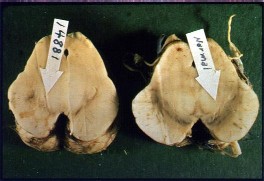
Parkinson's Disease strikes the neurons of the Nigrostriatal pathway, that is, the dopamine-releasing neurons whose cell bodies reside in the Substantia Nigra and synapse in the striatum (also known as the caudate/putamen). You generally have to lose about 90% of those neurons to get any symptoms. Really. The CNS covers its own a$$.
Interestingly enough, Huntington's Disease strikes the reciprocal connections, from the caudate to the SN, and elsewhere.....
Here's a brainstem cross-section of a PD patient and a person who died from something else. Not surprisingly, the substantia nigra is the black band near the bottom-middle.
Posted by: caltechgirl at
10:59 AM
| Comments (1)
| Add Comment
Post contains 108 words, total size 1 kb.
90kb generated in CPU 0.0527, elapsed 0.1417 seconds.
79 queries taking 0.1059 seconds, 218 records returned.
Powered by Minx 1.1.6c-pink.




